
Showing posts with label Photostats. Show all posts
Showing posts with label Photostats. Show all posts
9.25.2012


9.16.2012
A Scene from the Past 1986
Al’s Coffee Shop and the Chit Chat Lounge used to stand near the intersection of 6th Street and Rampart in Los Angeles along with the Big 6 Market, Queen Taco and the very car wash where they filmed the movie Car Wash! I spent an awful lot of time here as an art student at Otis/Parsons. Oh my, getting misty…

9.09.2012
"Sleeping with Women" by Kenneth Koch
Maybe my favorite poem ever is by this guy: Kenneth Koch. The actor Hienrich James turned me onto this magnum opus of literature and for that I am grateful. Read for yourself...

Sleeping With Women
Caruso: a voice.
Naples: sleeping with women.
Women: sleeping in the dark.
Voices: a music.
Pompeii: a ruin.
Pompeii: sleeping with women.
Men sleeping with women, women sleeping with women, sheep sleeping
with women, everything sleeping with women.
The guard: asking you for a light.
Women: asleep.
Yourself: asleep.
Everything south of Naples: asleep and sleeping with them.
Sleeping with women: as in the poems of Pascoli.
Sleeping with women: as in the rain, as in the snow.
Sleeping with women: by starlight, as if we were angels, sleeping on the train,
On the starry foam, asleep and sleeping with them — sleeping with women.
Mediterranean: a voice.
Mediterranean: a sea. Asleep and sleeping.
Streetcar in Oslo, sleeping with women, Toonerville Trolley
In Stockholm asleep and sleeping with them, in Skansen
Alone, alone with women,
The rain sleeping with women, the brain of the dog-eyed genius
Alone, sleeping with women, all he has wanted,
The dog-eyed fearless man.
Sleeping with them: as in The Perils of Pauline
Asleep with them: as in Tosca
Sleeping with women and causing all that trouble
As in Roumania, as in Yugoslavia
Asleep and sleeping with them
Anti-Semitic, and sleeping with women,
Pro-canary, Rashomon, Shakespeare, tonight, sleeping with women
A big guy sleeping with women
A black seacoast's sleeve, asleep with them
And sleeping with women, and sleeping with them
The Greek islands sleeping with women
The muddy sky, asleep and sleeping with them.
Sleeping with women, as in a scholarly design
Sleeping with women, as if green polarity were a line
Into the sea, sleeping with women
As if wolverines, in a street line, as if sheep harbors
Could come alive from sleeping with women, wolverines
Greek islands sleeping with women, Nassos, Naxos, Kos,
Asleep with women, Mykonos, miotis,
And myositis, sleeping with women, blue-eyed
Red-eyed, green-eyed, yellow reputed, white-eyed women
Asleep and sleeping with them, blue, sleeping with women
As in love, as at sea, the rabbi, asleep and sleeping with them
As if that could be, the stones, the restaurant, asleep and sleeping with them,
Sleeping with women, as if they were knee
Arm and thigh asleep and sleeping with them, sleeping with women.
And the iris peg of the sea
Sleeping with women
And the diet pill of the tree
Sleeping with women
And the apology the goon the candlelight
The groan: asking you for the night, sleeping with women
Asleep and sleeping with them, the green tree
The iris, the swan: the building with its mouth open
Asleep with women, awake with man,
The sunlight, asleep and sleeping with them, the moving gong
The abacus, the crab, asleep and sleeping with them
And moving, and the moving van, in London, asleep with women
And intentions, inventions for sleeping with them
Lands sleeping with women, ants sleeping with women, Italo-Greek or
Anglo-French orchestras
Asleep with women, asleep and sleeping with them,
The foam and the sleet, asleep and sleeping with them,
The schoolboy's poem, the crippled leg
Asleep and sleeping with them, sleeping with women
Sleeping with women, as if you were a purist
Asleep and sleeping with them.
Sleeping with women: there is no known form for the future
Of this undreamed-of view: sleeping with a chorus
Of highly tuned women, asleep and sleeping with them.
Bees, sleeping with women
And tourists, sleeping with them
Soap, sleeping with women; beds, sleeping with women
The universe: a choice
The headline: a voice, sleeping with women
At dawn, sleeping with women, asleep and sleeping with them.
Sleeping with women: a choice, as of a mule
As of an island, asleep or sleeping with them, as of a Russia,
As of an island, as of a drum: a choice of views: asleep and sleeping with
them, as of high noon, as of a choice, as of variety, as of the sunlight, red
student, asleep and sleeping with them,
As with an orchid, as with an oriole, at school, sleeping with women, and you
are the one
The one sleeping with women, in Mexico, sleeping with women
The ghost land, the vectors, sleeping with women
The motel man, the viaduct, the sun
The universe: a question
The moat: a cathexis
What have we done? On Rhodes, man
On Samos, dog
Sleeping with women
In the rain and in the sun
The dog has a red eye, it is November
Asleep and sleeping with them, sleeping with women
This June: a boy
October: sleeping with women
The motto: a sign; the bridge: a definition.
To the goat: destroy; to the rain: be a settee.
O rain of joy: sleeping with women, asleep and sleeping with them.
Volcano, Naples, Caruso, asleep and sleeping, asleep and sleeping with them
The window, the windrow, the hedgerow, irretrievable blue,
Sleeping with women, the haymow, asleep and sleeping with them, the canal
Asleep and sleeping with them, the eagle's feather, the dock's weather, and the
glue:
Sleeping with you; asleep and sleeping with you: sleeping with women.
Sleeping with women, charming aspirin, as in the rain, as in the snow,
Asleep and sleeping with you: as if the crossbow, as of the moonlight
Sleeping with women: as if the tractate, as if d'Annunzio
Asleep and sleeping with you, asleep with women
Asleep and sleeping with you, asleep with women, asleep and sleeping with
you, sleeping with women
As if the sun, as of Venice and the Middle Ages' "true
Renaissance had just barely walked by the yucca
Forest" asleep and sleeping with you
In China, on parade, sleeping with women
And in the sun, asleep and sleeping with you, sleeping with women,
Asleep with women, the docks, the alley, and the prude
Sleeping with women, asleep with them.
The dune god: sleeping with women
The dove: asleep and sleeping with them
Dials sleeping with women; cybernetic tiles asleep and sleeping with them
Naples: sleeping with women; the short of breath
Asleep and sleeping with you, sleeping with women
As if I were you — moon idealism
Sleeping with women, pieces of stageboard, sleeping with women
The silent bus ride, sleeping with you.
The chore: sleeping with women
The force of a disaster: sleeping with you
The organ grinder's daughter: asleep with bitumen, sunshine, sleeping with
women,
Sleeping with women: in Greece, in China, in Italy, sleeping with blue
Red green orange and white women, sleeping with two
Three four and five women, sleeping on the outside
And on the inside of women, a violin, like a vista, women, sleeping with
women
In the month of May, in June, in July
Sleeping with women, "I watched my life go by" sleeping with women
A door of pine, a stormfilled valentine asleep and sleeping with them
"This Sunday heart of mine" profoundly dormoozed with them
They running and laughing, asleep and sleeping with them
"This idle heart of mine" insanely "shlamoozed" asleep and sleeping with them,
They running in laughter
To the nearest time, oh doors of eternity
Oh young women's doors of my own time! sleeping with women
Asleep and sleeping with them, all Naples asleep and sleeping with them,
Venice sleeping with women, Burgos sleeping with women, Lausanne sleeping
with women, hail depth-divers
Sleeping with women, and there is the bonfire of Crete
Catching divorce in its fingers, purple sleeping with women
And the red lights of dawn, have you ever seen them, green ports sleeping with
women, acrobats and pawns,
You had not known it ere I told it you asleep with women
The Via Appia Antica asleep with women, asleep and sleeping with them
All beautiful objects, each ugly object, the intelligent world,
The arena of the spirits, the dietetic whisky, the storms
Sleeping with women, asleep and sleeping with them,
Sleeping with women. And the churches in Antigua, sleeping with women
The stone: a vow
The Nereid: a promise — to sleep with women
The cold — a convention: sleeping with women
The carriage: sleeping with women
The time: sometimes
The certainty: now
The soapbox: sleeping with women
The time and again nubile and time, sleeping with women, and the time now
Asleep and sleeping with them, asleep and asleep, sleeping with women, sleep
and sleeping with them, sleeping with women.

9.08.2012
Про Это
Oh my, I love this image. These are photostats of a design by the always amazing Alexander Rodchenko. This is actually, originally, the cover design for a book of poetry by Vladimir Mayakovski. For This or About This, as I understand it, is the translation into English. The woman there is Mayakovski's sweetheart, Lilya Brik, to whom the poem is written. I've seen this great design since appropriated by various concerns but for me and my friends, it was the standard for our band in 1985, Pro Eto.


9.07.2012
Boi-oi-oing! 1987


8.26.2012
Hands of Protection 1987
While deep in my 23 obsession, I had read in the Principia Discordia that the Erisians had adopted the Winston Churchill V-for-Victory sign as their own twenty-three hand-signal (two fingers up and three fingers down). Later, of course, that got co-opted by the hippies as a peace sign. Well, I wanted my own 23 signal free from any association to peace or victory so I closed the fingers or, as often, crossed them in the hope of creating something unique and still recognizable.
This image, by the way, was made on the old Sugar Turbine - the copier that Ed rescued, I repaired and we all used to print the 23 Press books.

7.29.2012
The Photostatic Twentythree 1987
See, before we all had computers, people had to do their graphic design with prestype and photocopiers, drawing with scissors and scotch tape. Or at least I did. Ed found a copier once in someone's trash and called me. We took it to a service shop to see if we could get it going again. My sister, Harriet, staked me the two-hundred-and-some-odd dollars it took to fix the drum and replace the corona wire and in a week I had a photocopier of my own which, in that day, was a very big deal. Someone dubbed it the Sugar Turbine and I got to work printing books for the Twentythree Press (yes - no hyphen) and whatever else I wanted. Happy times.


7.22.2012
23 No.1 1989
Wish I could describe just how and why I'm so drawn to the number 23 and one day I'll try. For now, here's a page from the Sentimental Sourcebook which I made as a personal reference to take with me to Budapest back in the Gasoline Days of 1989.

5.02.2011


3.26.2009
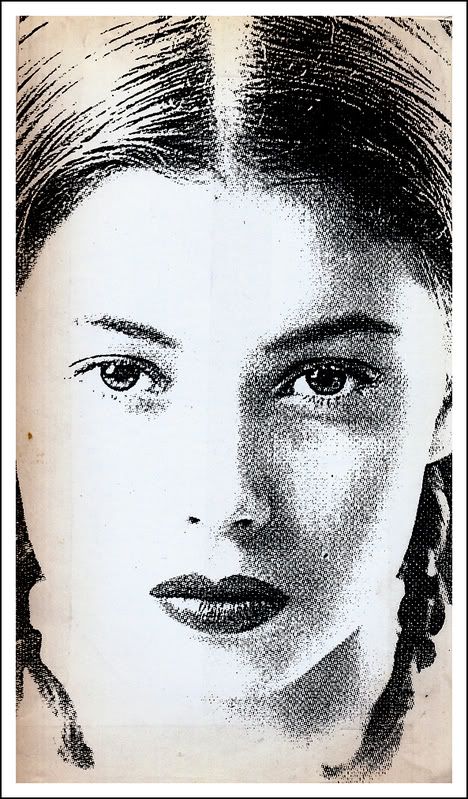
A Photostat of Jane March (1997)
Does anyone remember how beautiful Jane March was in The Lover?
A film of the Marguerite Duras story it was, and narrated by Jeanne Moreau even, I think.
Jean-Jacques Annaud was the director of it who described, "the din of the heat," so well for this.
I wish I had more to say about it.
I dont.

But this guy sure does.
A film of the Marguerite Duras story it was, and narrated by Jeanne Moreau even, I think.
Jean-Jacques Annaud was the director of it who described, "the din of the heat," so well for this.
I wish I had more to say about it.
I dont.
But this guy sure does.
3.23.2009
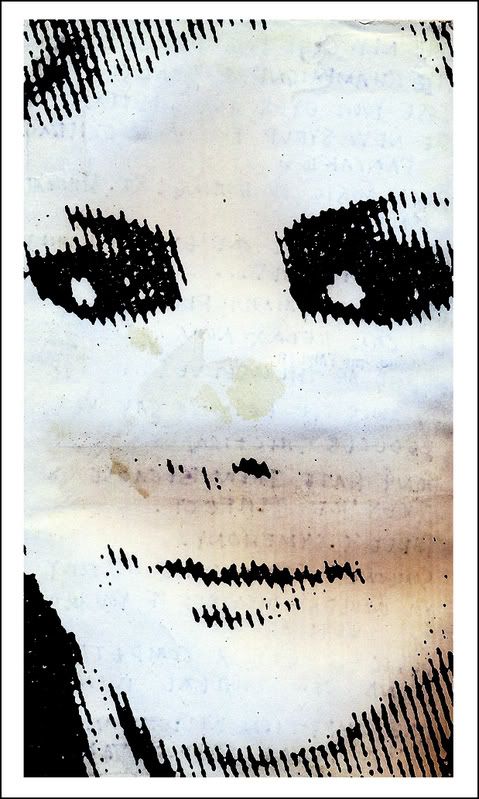
Miss You, Kirsty (1997)
Sadly, she's not alive anymore.
She was swimming in Cuban waters and got run over by a speedboat or something is what I heard.
A stupid shame, for sure.
Now she sings for the Choir Invisible (metaphorically) and they never sounded better!
Here's a photocopy I made of her in, like, 1997 or thereabouts.
If you wanna check out some Kirsty, there's a 'best of' album you can download by clicking this.
And there's more to be learnt here, too.
Added: Heres an accurate account of Kirsty's tragic/heroic passing (from Wikipedia)...
MacColl had a busy, successful year in 2000, with the success of Tropical Brainstorm, as well as her participation in the presentation of a radio programme she had done for the BBC on Cuba. MacColl decided to take a much needed holiday, and she, her partner, musician James Knight and her sons travelled to Cozumel, Mexico. She intended to introduce her sons during the trip to an activity she loved – scuba diving. On 18 December 2000, she and her sons went diving in Cozumel, in a specific diving area that watercraft were restricted from entering. With the group was a local veteran divemaster, Iván Díaz. As the group was surfacing from a dive, a speeding powerboat entered the restricted area. MacColl saw the boat coming before her sons. Louis was not in the boat's path, but Jamie was. She was able to push him out of the way (he sustained minor head and rib injuries) but in doing so, she was hit by the boat and killed instantly. MacColl's remains were repatriated to the United Kingdom and the subsequent funeral took place at Mortlake Crematorium in London.
The boat involved in the accident was owned by Mexican supermarket millionaire Guillermo González Nova, who was on board with several members of his family. An employee of González Nova's, boathand José Cen Yam, claimed to have been driving the boat at the time that the accident occurred. Several published reports have included accounts from eyewitnesses that have stated Cen Yam was not at the controls; eyewitnesses also indicate that the boat was travelling much faster than the speed of one knot that Nova had claimed. Cen Yam was found guilty of culpable homicide and was sentenced to 2 years 10 months in prison. However, he was allowed under Mexican law to pay a punitive fine of 1034 pesos (about £61 or US$90) in lieu of the prison sentence. He was also ordered to pay approximately US $2150 in restitution to MacColl's family, an amount based on his wages. Published reports have included statements from people who spoke to Cen Yam after the accident, claiming Cen Yam had received money for taking the blame for the incident.
MacColl had a busy, successful year in 2000, with the success of Tropical Brainstorm, as well as her participation in the presentation of a radio programme she had done for the BBC on Cuba. MacColl decided to take a much needed holiday, and she, her partner, musician James Knight and her sons travelled to Cozumel, Mexico. She intended to introduce her sons during the trip to an activity she loved – scuba diving. On 18 December 2000, she and her sons went diving in Cozumel, in a specific diving area that watercraft were restricted from entering. With the group was a local veteran divemaster, Iván Díaz. As the group was surfacing from a dive, a speeding powerboat entered the restricted area. MacColl saw the boat coming before her sons. Louis was not in the boat's path, but Jamie was. She was able to push him out of the way (he sustained minor head and rib injuries) but in doing so, she was hit by the boat and killed instantly. MacColl's remains were repatriated to the United Kingdom and the subsequent funeral took place at Mortlake Crematorium in London.
The boat involved in the accident was owned by Mexican supermarket millionaire Guillermo González Nova, who was on board with several members of his family. An employee of González Nova's, boathand José Cen Yam, claimed to have been driving the boat at the time that the accident occurred. Several published reports have included accounts from eyewitnesses that have stated Cen Yam was not at the controls; eyewitnesses also indicate that the boat was travelling much faster than the speed of one knot that Nova had claimed. Cen Yam was found guilty of culpable homicide and was sentenced to 2 years 10 months in prison. However, he was allowed under Mexican law to pay a punitive fine of 1034 pesos (about £61 or US$90) in lieu of the prison sentence. He was also ordered to pay approximately US $2150 in restitution to MacColl's family, an amount based on his wages. Published reports have included statements from people who spoke to Cen Yam after the accident, claiming Cen Yam had received money for taking the blame for the incident.
2.14.2009
Two Valentines (19??/19??)
Happy Valentine's Day!
Here's hoping the year so far has broughten you all the love you desire!
And also that that desired amount is reasonable and modest.
You don't want to make a pig of yourself.
I think that as long as the love you desire does not exceed the love you deserve, you're pretty much okay.
But even less than that is better.
Sometimes, you know, it's difficult to gauge how much you deserve.
People usually way overestimate.
I suggest you take what you think is fair, and then cut that in half.
Then cut that half in half and you're probably okay.
An expectation of nothing is, of course, best.
Anyhow, here're a couple valentines I sent out years ago.
Or, well, obviously I didn't send these very ones, but others like em I did, for sure.
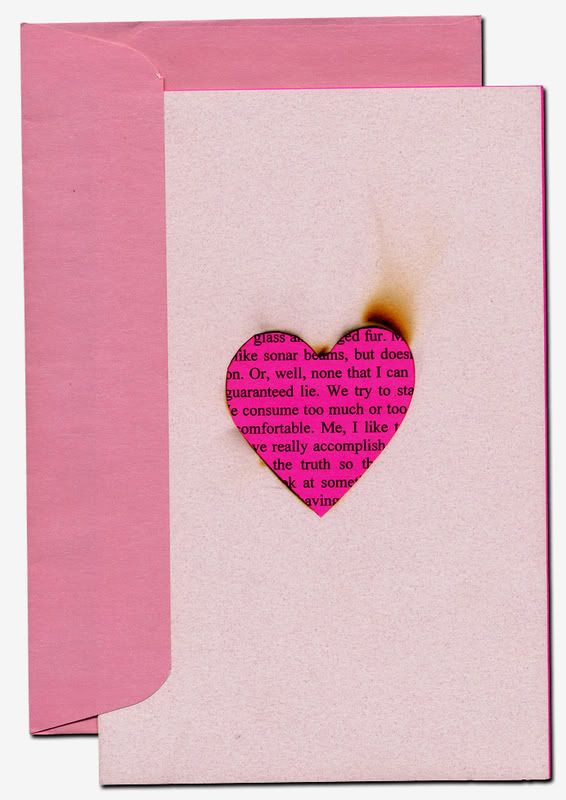
This one's from like '97 or '98.
I remember just having met Lois Chiles around that time (Yes! THE Lois Chiles! Not making this up!) and sending her one along with everyone else. Of course there was a full page of text behind the cover with the perforation and I remember feeling maybe just a little bit weird about this one line in there about, "your nipples in my mouth" or something...

Here's hoping the year so far has broughten you all the love you desire!
And also that that desired amount is reasonable and modest.
You don't want to make a pig of yourself.
I think that as long as the love you desire does not exceed the love you deserve, you're pretty much okay.
But even less than that is better.
Sometimes, you know, it's difficult to gauge how much you deserve.
People usually way overestimate.
I suggest you take what you think is fair, and then cut that in half.
Then cut that half in half and you're probably okay.
An expectation of nothing is, of course, best.
Anyhow, here're a couple valentines I sent out years ago.
Or, well, obviously I didn't send these very ones, but others like em I did, for sure.
This one's from like '97 or '98.
I remember just having met Lois Chiles around that time (Yes! THE Lois Chiles! Not making this up!) and sending her one along with everyone else. Of course there was a full page of text behind the cover with the perforation and I remember feeling maybe just a little bit weird about this one line in there about, "your nipples in my mouth" or something...
True story.

Yeah, and this one's from... I'm gonna say '89 or '90 or '91 and was sent naked like a postcard, but mounted on a piece of 1/2" thick foamcore. It's always fun to challenge the U.S.P.S. but get this: my buddy Ed told me that just after the cards went out that he went down to his local Post Office, back when he was on Cahuenga in Hollywood, and one of our esteemed postal workers had xeroxed one of the cards and taped the copy up on the wall for their customers to enjoy.
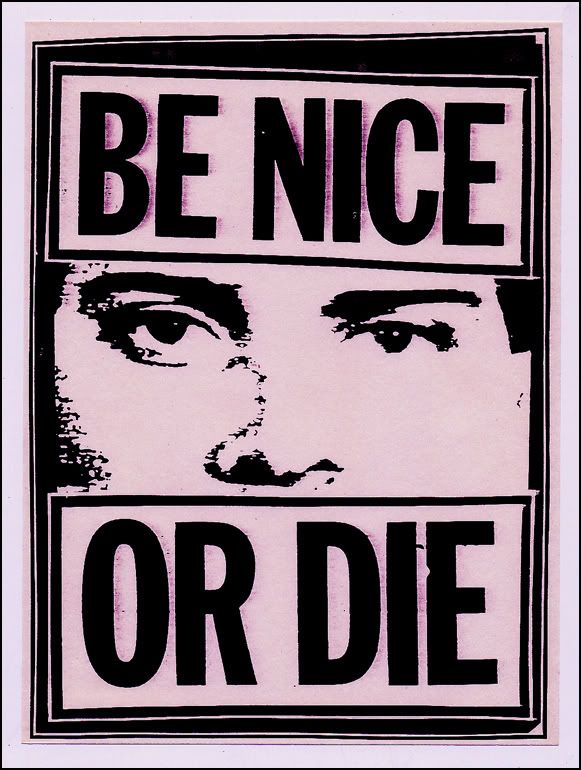
A shining moment in my career and a story I'll have to remember the next time I'm feeling suicidal.
2.13.2009
2.11.2009
Lesley Gore

Interview with Lesley Gore
by Shauna Swartz,
LG: Well, there were was very little acceptance of gay people. I think the record industry, by and large what’s left of it, is still totally homophobic. I think it’s much less so in the film industry now, but the record industry, it’s always been a man’s world. It’s always been a patriarchal situation, and it’s always put women, not necessarily down, but certainly on a lower rung.
AE: I wonder why that would be so different from the film industry.
You know, Quincy Jones was a great mentor, but he was a man in a man’s world. Fortunately he’s a very sensitive man and a beautiful human being, and even though he was 14 or 15 years older than me, he’s a capable human being and has great communication skills. He was able to get a great performance out of me because he made me feel comfortable in the studio. But I know I had a conversation just a couple of days ago with Kathleen Hanna of Le Tigre, and she said to me, “Who were your female mentors?” And I said, Gosh, I didn’t have any. There weren’t any.
I had many people that I idolized who were singers like Sarah Vaughan and Dinah Washington, but these weren’t exactly women I could call up every day and say, Hey, how’s it going, you know?
So I didn’t have a woman mentor until many years later—many, many years later when I became friendly with Bella Abzug. She kind of mentored me as to what’s important for women and where to put my energies in terms of gay women, and what I could best do to help women in our community and children. And that’s pretty much what I live by now, pretty much where I like to concentrate my efforts. You can only bite off so much, so you gotta know what you want to do.
AE: You mentioned that you were having a conversation with Kathleen Hanna. How did that come about?
AE: So, you said that you interviewed k.d. lang. When was that?
AE: Was that the first time you met her?
AE: So, who are you listening to these days?
AE: Nothing that you wanted your name associated with?
AE: I read, I think in Vanity Fair, that the parts you did contribute to that came from genuine anger that you felt at the time. I was wondering if you could elaborate on that.
AE: When did you transition from performing other people’s material to writing your own?
LG: Absolutely. It always is trying to self-motivate. I think it’s the hardest thing a person can do.
AE: Is it still a struggle?
AE: You said that it was a double-edged sword, your rapid fame. Can you tell me what was rewarding, what were the good parts of it?
AE: It seems like it would’ve been difficult at such a young age to maintain friendships; it must have shocked your friends as much as it shocked you when things took off.
AE: That must’ve been difficult.
by Shauna Swartz,
June 23, 2005
Former 60s teen idol Lesley Gore, who is best known for her classic songs "It's My Party (I'll Cry if I Want To)" and "You Don't Own Me," talks to us about her career, her new album, and why she hasn't officially come out as a lesbian (until now).
AfterEllen.com: So, you’re about to tour with your new album, beginning in New York--is that right?
Lesley Gore: Yes. We’re concentrating on New York during the summer…kind of trying to sneak it out in New York over the summer and then on a more national level come September. The release date is June 28th and our first performance is at Joe’s Pub. New York is where I live.
AE: Do you live alone--besides with your dog [which appears in a photo with her on the In the Life website]?
LG: I have a partner of 23 years and I have a cocker spaniel who turned two--what’s today?--she turned two on Friday, June 4th. Little Billie, named after Billie Holiday, one of my favorite singers. And I thought, you know, a little gender confusion makes a better person. A little adversity in life at an early age. It’s character building.
Former 60s teen idol Lesley Gore, who is best known for her classic songs "It's My Party (I'll Cry if I Want To)" and "You Don't Own Me," talks to us about her career, her new album, and why she hasn't officially come out as a lesbian (until now).
AfterEllen.com: So, you’re about to tour with your new album, beginning in New York--is that right?
Lesley Gore: Yes. We’re concentrating on New York during the summer…kind of trying to sneak it out in New York over the summer and then on a more national level come September. The release date is June 28th and our first performance is at Joe’s Pub. New York is where I live.
AE: Do you live alone--besides with your dog [which appears in a photo with her on the In the Life website]?
LG: I have a partner of 23 years and I have a cocker spaniel who turned two--what’s today?--she turned two on Friday, June 4th. Little Billie, named after Billie Holiday, one of my favorite singers. And I thought, you know, a little gender confusion makes a better person. A little adversity in life at an early age. It’s character building.
AE: Our readers are interested in representations of lesbians and bisexual women in the media, and I imagine a lot of them will be surprised to be able to claim you amongst ourselves. I was wondering, have you ever come out on the record?
LG: On the record? Well, you know, it’s funny. I just never found it was necessary because I really never kept my life private. Those who knew me, those who worked with me were well aware. And what I actually started doing was, well, for a couple of years now I’ve been hosting [the PBS series] In the Life, and that was just kind of my way of saying, here I am and this is what I feel I should be doing now, and it was sort of a natural evolution for me as opposed to, you know, this great gong in the head.
AE: I knew you had hosted an In the Life episode earlier this year. I didn’t realize you’ve been doing it for two years.
LG: Yeah, the show I just hosted is I think the second one I’ve done for them, and I think they’re terrific people and they know if they ever need to call upon me, I’m there. It’s a great program.
You know, the interesting thing about having traveled around the country as much as I have, and I think it’s sort of inadvertently what made me come out or at least begin doing things within the community and thinking more about that, was that I get to travel quite a bit. I meet a lot of young people in the Midwest, and I saw what a difference a show like In the Life can make to their lives in some of these small towns where, you know, there are probably two gay people in the whole damn town. It’s made a real inroads for them. They come and they talk to me about this stuff, so I know how important it is.
You know, the interesting thing about having traveled around the country as much as I have, and I think it’s sort of inadvertently what made me come out or at least begin doing things within the community and thinking more about that, was that I get to travel quite a bit. I meet a lot of young people in the Midwest, and I saw what a difference a show like In the Life can make to their lives in some of these small towns where, you know, there are probably two gay people in the whole damn town. It’s made a real inroads for them. They come and they talk to me about this stuff, so I know how important it is.
AE: Would you say that people knew you were gay back when you were first performing? You were pretty young, about 17, right?
LG: Well, I didn’t know until I was in my twenties, so if they knew it, they knew it before I did. [Laughs] You know, maybe someone did think that. I don’t know, but I certainly didn’t know it until I was in my twenties.
AE: Once you did know, did you have to go to lengths to conceal it in the music industry?
LG: Well, I don’t think I went to lengths. I just kind of lived my life naturally and did what I wanted to do. I didn’t avoid anything, I didn’t put it in anybody’s face. Times were very different then, so, you know, I just tried to live as normally as humanly possible. But as truthfully as humanly possible.
AE: And how would you say that times were different?
AE: And how would you say that times were different?
LG: Well, there were was very little acceptance of gay people. I think the record industry, by and large what’s left of it, is still totally homophobic. I think it’s much less so in the film industry now, but the record industry, it’s always been a man’s world. It’s always been a patriarchal situation, and it’s always put women, not necessarily down, but certainly on a lower rung.
AE: I wonder why that would be so different from the film industry.
LG: It is fascinating to know. You know, I read an article a couple of weeks ago in the New York Times talking about how many new women CEOs are in film companies, and it’s certainly been a long and gradual change. And there are, of course, some women in the music industry who have always been there and have been pioneers and there were even a couple back in the fifties--Florence Greenberg, for example, who started Scepter Records. She was one of a kind. She was one woman in a field of men. And I think because the industry is so stymied, a lot of women haven’t fought for their rightful place. Um, the record companies are disappearing, so I think women are finding different ways to go into communications.
AE: It seems like it would be a little bit easier in the film industry just because you have certain parts that have to be performed by women, whereas with music--
LG: True enough. I can remember in the early ‘60s that there were a couple of really dynamic women performers at the time--Brenda Lee, there was Connie Francis. And because the fact that they, on a huge show, they usually used twenty male groups and one female, it was years before I ever met Connie or Brenda because we were never on the same show.
AE: It seems like that was sort of an era when there were a lot of women songwriters and girl groups coming out, but I guess in terms of their percentage…
AE: It seems like that was sort of an era when there were a lot of women songwriters and girl groups coming out, but I guess in terms of their percentage…
LG: It was still a low percentage. Given that there was that era of girl group music and it’s still very popular, but I think if you looked at the chart from that time you would see many more men on it. Because the industry, they were catering to young girls. I mean, that’s what they thought their audience was. So you can understand their logic, but I don’t think it necessarily gave women the role models that we needed. I know I had to kind of search for mine. I mean, I had mentors.
You know, Quincy Jones was a great mentor, but he was a man in a man’s world. Fortunately he’s a very sensitive man and a beautiful human being, and even though he was 14 or 15 years older than me, he’s a capable human being and has great communication skills. He was able to get a great performance out of me because he made me feel comfortable in the studio. But I know I had a conversation just a couple of days ago with Kathleen Hanna of Le Tigre, and she said to me, “Who were your female mentors?” And I said, Gosh, I didn’t have any. There weren’t any.
I had many people that I idolized who were singers like Sarah Vaughan and Dinah Washington, but these weren’t exactly women I could call up every day and say, Hey, how’s it going, you know?
So I didn’t have a woman mentor until many years later—many, many years later when I became friendly with Bella Abzug. She kind of mentored me as to what’s important for women and where to put my energies in terms of gay women, and what I could best do to help women in our community and children. And that’s pretty much what I live by now, pretty much where I like to concentrate my efforts. You can only bite off so much, so you gotta know what you want to do.
AE: Right. She sounds like she was really a remarkable woman.
LG: Oh my gosh, she was remarkable, and a great, great, dear friend. And we lost her too early, and it was seven years ago recently and it feels like yesterday. The whole community really misses her a lot. We all get together periodically, and it’s Bella we talk about, because she was so dynamic and we miss her so. And there are so few women who can pull women together that way. She was a great human being, a great woman.
AE: You mentioned that you were having a conversation with Kathleen Hanna. How did that come about?
LG: Yeah, it was great actually--we did a kind of interview; she interviewed me for Ms. Magazine, and it’s kind of based on some years ago in Ms., I had interviewed k.d. lang, and it was sort of a singer-to-singer kind of a thing, and they wanted to kind of recreate that with me being questioned, and they thought it would be interesting for Kathleen to do it because, she, after all these years of being an independent songwriter and artist, has become mainstream. She’s now on a label, which is under the Universal Music Group heading, so she’s got the big machinery behind her now. And I’ve moved to a little indie label, you know, where we pretty much do everything ourselves, and it’s all exclusively on the Net. So, we kind of changed positions, and we kind of had fun talking about that and looking into the future a little.
AE: And when is that issue coming out?
LG: I don’t think that will be out much before September. She’s a great gal. A really great gal, and very smart. It was a pleasure.
AE: So, you said that you interviewed k.d. lang. When was that?
LG: It was about thirteen or fourteen years ago.
AE: Was that the first time you met her?
LG: Yeah, actually what I had done was, she was performing in Rochester, so I took a plane up there and I saw her concert like on a Tuesday or a Wednesday night, and then we did our conversation the next morning. So I had an opportunity to meet her after the performance and meet the band, and actually see the show. I had heard her records before but I had never seen her in person, and I thought that was an important part of the interview.
AE: So, who are you listening to these days?
LG: [Laughs] Lesley Gore. Actually, the funny thing is, after all these years, I’ve got all these new songs to learn for the show we’re doing at Joe’s Pub, so it’s kind of fun to get down and rehearse new things, and also rethink some of the older songs, how we’re going to do them. It’s kind of fun. It’s a whole new challenge.
AE: I wanted to ask you about Grace of My Heart. I’ve read that Bridget Fonda's closeted lesbian teen character Kelly Porter was based at least partially on you.
LG: Well, I think that’s what they were trying to intimate. Was it true? I don’t know, everyone seemed to be based on somebody and yet the stories weren’t absolutely carved in stone. There was sort of a Carole King character, sort of a Brian Wilson character. So I think that was their intent.
AE: Did you have any input when they were developing that character?
LG: You know, I really didn’t. They called me up to write one of the songs and I felt good that they called me, and then the next thing I knew, I received a song in the mail written by two guys, whose names I can’t even remember, and I was so disappointed that I wasn’t brought in on the ground level. And basically when I heard the song, I thought it was kind of terrible, so what I wound up doing is what I call doctoring, which is making some changes to make it a little more palatable. There were things that were totally unmelodic, and there were some lyrics that were just horrible, and I wound up making it, to my mind, a little bit better, and then I got a third writer’s credit. And then they had the nerve never even to invite me to the opening when it premiered in New York. So I say fuck them. [Laughs] So if it was meant to be me, they didn’t handle it very well. There may have been some exploitative motive there--I won’t second guess it--but that’s what I suspect.
AE: When you say some of the lyrics were less than palatable in the original song, did they seem homophobic?
AE: When you say some of the lyrics were less than palatable in the original song, did they seem homophobic?
LG: Oh, no. They just seemed bad. [Laughs] They weren’t homophobic at all, just bad rhymes and incorrect grammar--just real pet peeves of mine.
AE: Nothing that you wanted your name associated with?
LG: Not really. Until I put in a few lyrics that meant something to me, then I felt, well, at least I can put my name on it.
AE: I read, I think in Vanity Fair, that the parts you did contribute to that came from genuine anger that you felt at the time. I was wondering if you could elaborate on that.
LG: I don’t actually remember saying that, but I do remember feeling somewhat used by them and somewhat hurt by the whole situation. But I’ve outgrown it. [Laughs]
AE: Oh, I actually thought that wasn’t about the experience of working with them but about what you were feeling in the sixties.
LG: Ah, well, that did come out periodically. You know, "You Don’t Own Me" is a very powerful song: Don’t abuse me, don’t misuse me. It comes from the same place. It’s the “don’t” folder. The interesting thing about "You Don’t Own Me" is that it was written by two men, John Madera and Dave White, and they played me this song on guitar live at a hotel up in the Catskills in 1964 on a Saturday afternoon. And I had these guys come back to New York on Monday and meet with Quincy and me and play him the song and he fell in love with it. So you never know where these things are going to come from, but when I heard that song I knew I had to sing it.
AE: I was wondering if you could tell me a little bit about when you were first discovered, because I’ve read probably four different versions of it.
LG: Right. The short story and the truth is that I was taking vocal lessons here in New York with a wonderful vocal coach.
And one day, instead of my lesson, the piano player and I went into a studio right in the building and we put down some demos, just piano/voice. Those demos got to Quincy Jones through an agent by the name of Joe Glaser who was very friendly with Irving Green, who was president of Mercury, and Quincy was working at Mercury and Irving put my demos on his desk. He listened to them, he called me, and we started to record.
And one day, instead of my lesson, the piano player and I went into a studio right in the building and we put down some demos, just piano/voice. Those demos got to Quincy Jones through an agent by the name of Joe Glaser who was very friendly with Irving Green, who was president of Mercury, and Quincy was working at Mercury and Irving put my demos on his desk. He listened to them, he called me, and we started to record.
AE: When you did the demos were you about 16 years old?
LG: Yeah, I had just turned sixteen, and I was still sixteen when we cut "It’s My Party." In May of that year I turned 17.
AE: And what was that like growing up and maturing both musically and personally in the spotlight?
AE: And what was that like growing up and maturing both musically and personally in the spotlight?
LG: It was very difficult, to be honest with you. You have to take into account that this was a long time ago, and we didn’t have things like answering machines, okay? So when the disc jockey on WINS or WNCA, which was a big station here in New York, would say, “That was Lesley Gore, the sweetie pie from Tenafly,” well, people just came to Tenafly. You know, I’d wake up and there were people camped out on the grass.
Or they’d show up in town and someone would say “Where does Lesley live?” and they’d go, “Oh, up the hill, then you make a left over there and it’s the third house on the right.” And it was the same thing with the telephone. People got on the phone and said, "Give me Gore in Tenafly." So we were getting phone calls that we didn’t even understand half the time. So I was really thrown into it, and those things are, how shall I say, double-edged swords. There’s a lot of positive but there’s a lot of negative and you need to find a way to balance it out.
AE: It sounds like you really did not have much privacy.
Or they’d show up in town and someone would say “Where does Lesley live?” and they’d go, “Oh, up the hill, then you make a left over there and it’s the third house on the right.” And it was the same thing with the telephone. People got on the phone and said, "Give me Gore in Tenafly." So we were getting phone calls that we didn’t even understand half the time. So I was really thrown into it, and those things are, how shall I say, double-edged swords. There’s a lot of positive but there’s a lot of negative and you need to find a way to balance it out.
AE: It sounds like you really did not have much privacy.
LG: Well, no, we hardly expected it, to be honest with you. We recorded the record on a Saturday afternoon March 30th and I heard the record for the first time on April 6th. I was driving to school, literally seven days later. You know, that doesn’t happen anymore, so when it started getting played, we weren’t prepared for it. We didn’t even know it had been released.
AE: I heard that it got rushed out. And you always hope for it, but you couldn’t have known that it would be as incredibly successful as it was.
AE: I heard that it got rushed out. And you always hope for it, but you couldn’t have known that it would be as incredibly successful as it was.
LG: I’ll tell you the truth: When we left the studio, everyone was pleased, but even the president of the company, a wonderful father-like figure, Irving Green, said “Now, sweetheart, if this never gets released, I don’t want you to be disappointed.” And I said, “It’s okay, This has been a great experience. I enjoyed it and I thank you for that, and it’s okay if you never release it.” I never thought it would see the light of day.
AE: Really?
LG: Truly. I was 16 years old--what did I know? I went into a studio, that was an amazing experience, the whole band was there. Ellie Greewich and twelve singers were there--I mean, it doesn’t get any better than that. So if it was going to be released, I couldn’t even envision that. That was too far away to even think about.
AE: When did you transition from performing other people’s material to writing your own?
LG: You know there was a period of time in the ‘70s when I was living in California and there was not exactly a lot of work pouring in, a lot of these records, Party, You Don’t Own Me, there wasn’t enough perspective on them, there were no club dates, and I think I turned to writing really just to wake up in the morning and be a musician and to have something to do, and feel like a musician every day even if I wasn’t working.
And that’s what got me to the piano, that’s what got me up in the morning: a blank piece of paper and a hope to have something by the end of the day.
AE: Was it a struggle at first?
And that’s what got me to the piano, that’s what got me up in the morning: a blank piece of paper and a hope to have something by the end of the day.
AE: Was it a struggle at first?
LG: Absolutely. It always is trying to self-motivate. I think it’s the hardest thing a person can do.
AE: Is it still a struggle?
LG: I’m sort of used to it now. I don’t know any other lifestyle. I get up in the morning and I really do feel that the world is my oyster, and I start that way, the same as I would if I were preparing to write a song: put a blank piece of paper up on the piano and you go for it. That’s what you’re there to do.
AE: You said that it was a double-edged sword, your rapid fame. Can you tell me what was rewarding, what were the good parts of it?
LG: Well, people pay a lot of attention to you, and that’s kind of wonderful, and at the same time, after a while you go, Oh my God, enough’s enough. I’m only a little 16-year-old person. So I tried to keep my head through things. Doing Hullabaloo and doing Ed Sullivan were frightening but wondrous experiences, doing the T.A.M.I. show, performing in front of 50,000 people at Lake Ponchartrain--these are memories that are amazing.
The Tonight Shows the Merv Griffin Shows, Batman, Smokey Joe’s Café on Broadway--I’ve had some wonderful opportunities and I’ve tried to take advantage of as much as I possibly could whenever something came along.
The Tonight Shows the Merv Griffin Shows, Batman, Smokey Joe’s Café on Broadway--I’ve had some wonderful opportunities and I’ve tried to take advantage of as much as I possibly could whenever something came along.
AE: It seems like it would’ve been difficult at such a young age to maintain friendships; it must have shocked your friends as much as it shocked you when things took off.
LG: Absolutely. But you find a level. After two years, I had my hit when I was a junior in high school, "It’s My Party," and I matriculated into college a year and a half later. So I arrived as a sort of celebrity. Never a good idea in college. And it took a while but eventually I found my friends, on my level. I found people that I adored and felt that they adored me for all the right reasons. It’s like all things in life. You work it through and find people you can share things with.
AE: Was that in New York that you went to college?
AE: Was that in New York that you went to college?
LG: I went to Sarah Lawrence in Bronxville, which is only 30 minutes outside of New York. And I think that the reason I went there is I wanted to stay close to the music scene in New York--Quincy was still here--and also be able to do some TV. It was my first choice.
AE: How did you manage to keep up with the work and with your music?
LG: Well, I basically did not go on tour unless it was a holiday or summer. I pretty much tried to maintain as normal an educational schedule as possible. So there were times I would work on the weekends but maybe I would have to skip a Friday class to get there. But I stayed in school most of the week.
AE: That must’ve been difficult.
LG: Yeah, it was okay. I was a good student and I enjoyed school. It was good to get away from the attention. It was a good place to go, and if I didn’t have to travel on the weekend I enjoyed staying on campus and just sitting in the library all weekend. The school was a beautiful school and the campus was kind of like a haven for me. A beautiful school and an excellent philosophy. They treat women like human beings, and they were doing that back then. It felt really good to…to feel good being a woman, and Sarah Lawrence had a lot to do with helping me feel that way.
AE: So you started out at such a young age, but you’re also still in the recording industry now. Has being so famous so young affected your career as an adult?
AE: So you started out at such a young age, but you’re also still in the recording industry now. Has being so famous so young affected your career as an adult?
LG: Yeah, sure. Again, it’s a double-edged sword. "It’s My Party" will get me in the door but then I’ve gotta do it. You know, do you want to do that 42 years later? You take the good with the bad, and you make it work. There is no point in me getting up on a stage and not doing "It’s My Party." There’s no point.
AE: What do you mean by that?
LG: I’m saying there’s no reason why I shouldn’t do it. There’s every reason to do it. Where do you want to be: your career before or your career now? Well, they’re the same thing. It’s my career, it’s my life, it’s my work in progress. And I do "It’s My Party" ever since, and I’m just broadening my foundation a little. When I get up on stage I do "It’s My Party," I do "Sunshine Lollipops," I do all the songs people expect me to do, and then hopefully I give them a little something extra.
AE: I think a lot of artists would outright refuse to do that so many years later.
LG: That’s what I meant about it being a double-edged sword. You’ve got to realize your task at hand. There’s no point in alienating your fan base. What I think you want to do is bring them along and then pick up a few more people along the way. So, can you be bitter and make that choice? Sure you can, but it’s not one that I feel comfortable with.
AE: I know "You Don’t Own Me" is a favorite, especially at gay pride celebrations.
AE: I know "You Don’t Own Me" is a favorite, especially at gay pride celebrations.
LG: Exactly. Imagine me doing a show and not doing "You Don’t Own Me." It’s not going to happen. I can’t imagine an audience not being really unhappy if I didn’t sing "It’s My Party." And I’m not there to alienate. The idea is it’s entertainment; you’re supposed to make people happy.
AE: Are there any things about yourself, any misconceptions about you that you run up against online, in magazines and in daily life?
LG: Oh, absolutely. Very early on, when I was 16 my family and I were up in Detroit and we were doing a television show for WXYZ, sort of a lip-sync show--they were popular in almost every city in the ‘60s. We were staying at a Ramada hotel and there was a photographer following us around. So at one point my father was sitting in this large leather armchair and I stood next to him in front of a huge fireplace, four times taller than I am, and they snapped some pictures and then there was a limo that took us to the television station. Well, needless to say, the mansion of the television station became my home. The photo in front of the fireplace, that was my fireplace at home. The huge limo was... So, I went, "Well, this isn’t true." But it’s sort of the way publicity was done.
AE: And would you say it’s different now?
LG: No, I’d say it was pretty much the same, but I wasn’t prepared for out-and-out lies. I mean, could I live with them? Yeah, I could live with them. But as a result, people actually thought that I came from a wealthy family. And while I come from a very comfortable family, we were hardly wealthy. So I think they were trying to push a poor-little-rich-girl syndrome, and they did, so I think that’s how some people think of me. It was kind of a forced PR, a push.
AE: Are there things that you come up against currently that are misconceptions about you or misinformation that’s out there?
AE: Are there things that you come up against currently that are misconceptions about you or misinformation that’s out there?
LG: Well, there’s a lot of misinformation but that’s because there are so many websites. So I roll with the punches. I try not to get upset when I read things or feel as though something has been misperceived. Again, everything in life, not just show business, is a double-edged sword. You know, if you’ve got a lot of money, you’ve got to figure out how to be a good person with it. So even when your dreams come true, you‘ve gotta watch out. You know.
I’ve been watching what the press is doing to Angelina Jolie, and I look at that and I’m really just happy to be me. People look at me and they wave, “Hi, Lesley.”
They know me in the neighborhood. It’s no big deal. I lead a pretty normal life now. I don’t know how many poor kids survive when the press is out there to get the worst possible shot of you and to exploit you on that level. I had to deal with it a lot. I had stalkers through my life. Really you just gotta keep chugging along and keep a positive attitude and get through all the problems. You gotta face them, otherwise you don’t get through.
I’ve been watching what the press is doing to Angelina Jolie, and I look at that and I’m really just happy to be me. People look at me and they wave, “Hi, Lesley.”
They know me in the neighborhood. It’s no big deal. I lead a pretty normal life now. I don’t know how many poor kids survive when the press is out there to get the worst possible shot of you and to exploit you on that level. I had to deal with it a lot. I had stalkers through my life. Really you just gotta keep chugging along and keep a positive attitude and get through all the problems. You gotta face them, otherwise you don’t get through.
1.11.2009
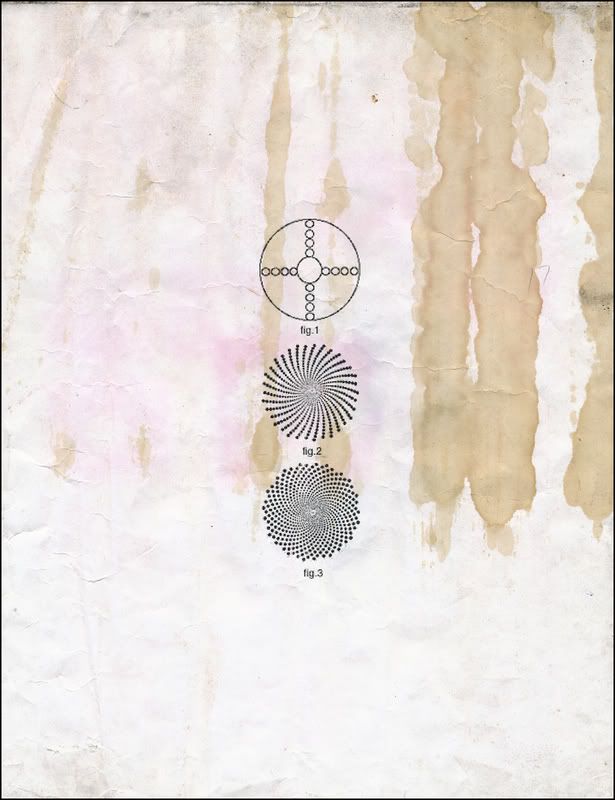
Paradise Artifact
I really love beautiful trash like this.
It came from Michael Paradise's studio,
from about the middle of last year.
We were hanging out,
just shitting around,
whatever it is we do,
and he started burning this incense the scent of which I found especially appealing.
I asked if I could snag a few sticks and he wrapped some in this paper,
one of many which regularly litter his habitat,
wherever he may reside.
I stuck the gift in my bag,
my poor, gone bag,
and it remained there at the bottom for a while.
I guess I forgot about it and in that time it got wet somehow.
Probably set the bag down in the rain or stuck a cold bottle of something in it.
Who knows.
The wet incense made a nice pattern on the paper, though, right?
And the sticks dried out and lit up just fine.
I think those three circles were part of one of his art lessons or something.
That's what Mike does,
is teach art.

It came from Michael Paradise's studio,
from about the middle of last year.
We were hanging out,
just shitting around,
whatever it is we do,
and he started burning this incense the scent of which I found especially appealing.
I asked if I could snag a few sticks and he wrapped some in this paper,
one of many which regularly litter his habitat,
wherever he may reside.
I stuck the gift in my bag,
my poor, gone bag,
and it remained there at the bottom for a while.
I guess I forgot about it and in that time it got wet somehow.
Probably set the bag down in the rain or stuck a cold bottle of something in it.
Who knows.
The wet incense made a nice pattern on the paper, though, right?
And the sticks dried out and lit up just fine.
I think those three circles were part of one of his art lessons or something.
That's what Mike does,
is teach art.
1.08.2009
Me, Once

This first one is a picture of me and some anonymous club girl at the Fetish in L.A. 'round about 1984, I think. I'm pretty sure this would've been the Berwin Complex location (it moved around a lot) and the photograph was taken by some guy, not sure who, interested in that culture or who thought that all us freakazoids was good camera fodder. True to his word, though, he showed up the next weekend with a print for anyone he'd shot the Saturday before.
Funny thing is, now that guy is me. Now I'm (occasionally) the guy in the club or the bar who takes pictures of the scenesters - from the outside looking in, sort of.
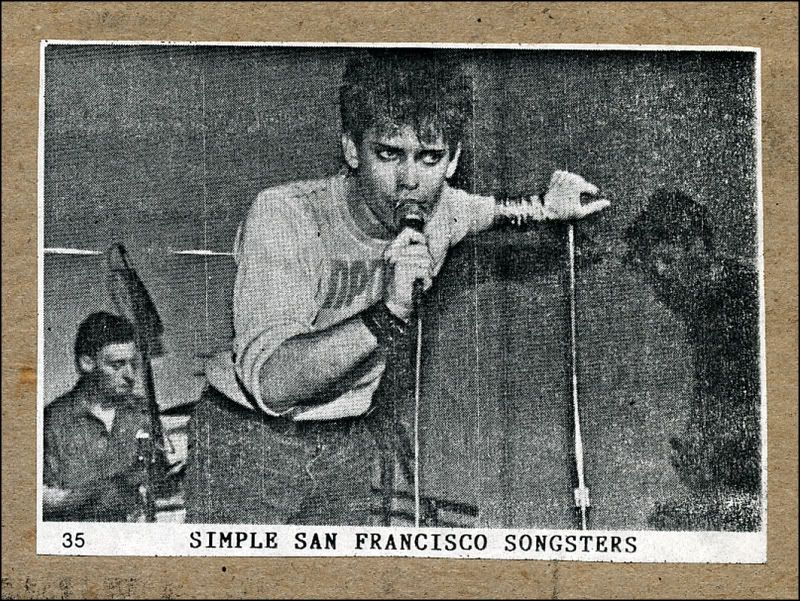
And this one, oh my. Did I mention I was in a band once? Yeah, me and my best friends from art school, David and Ed, started up this thing around '85 called... well, first it was the Negative Raccoon Effect. Sure - y'know, the NRE. And then we changed it to Simple. But the guy at the recording studio in Berkley where we made our demo tape thought that was a bad idea, what with the burgeoning popularity of Simple Minds, and we should avoid any confusion, etc...
At the time I was really, really into Russian Constructivism and, in particular, the designs of Aleksandr Rodchenko and, in particular, this one piece, the cover of a book of poetry by Vladimir Mayakovsky called про зто (pronounced in english, Pro Eto). So we called ourselves that, which translated to... well, it was never quite clear. Different sources - different answers. It was either, "For This," or, "About This," or, "Because of This," or something ridiculously slight. For me, I have to say, it didn't much matter as I was just so in love with the graphic, it's source, and the knowledge that we had the coolest band logo ever - already built into the name.
That's how I operated. I mean, yes, I was the singer and I wrote the words to the songs (such as they were) and a little of the music but my principle interest was in packaging our 'product' or 'image' or whatever. So I spent a whole lot more time on pictures and posters and flyers than I did on learning to play my guitar. Just looking at this blog, that can't come as much of a shock.
Plus, I have an awful singing voice.
Here are some photostats of photographs taken by David Hermon, who shot many of the bands in the scene at that time and who was a fan of ours (and so shot for nothing).One of my aforementioned and still best friends, Edward Pollard, who played bass guitar in the band through it's many iterations (the story does go on into the nineties) has, in fact, written a novel based on his experiences during this slice of our lives. Exerpts from his adapted account can be found here.
And since were already here, and since I already have 'em scanned...
Here's Ed.

This is David Bornstien, our guitar player and principle tune writer and someone I miss a whole lot.

And me again.

A collage layout based around another David Hermon photo...

One of my very early flyers...

more David Hermon shots...


And our press kit photo.

12.27.2008
Reject Me, I'm Yours!(1993/2008/2007)
These things, going back a few years, um, like to 1993, were the result or, perhaps, by-product of a batch of designs I did for the Hungarian rock band, Andersen.


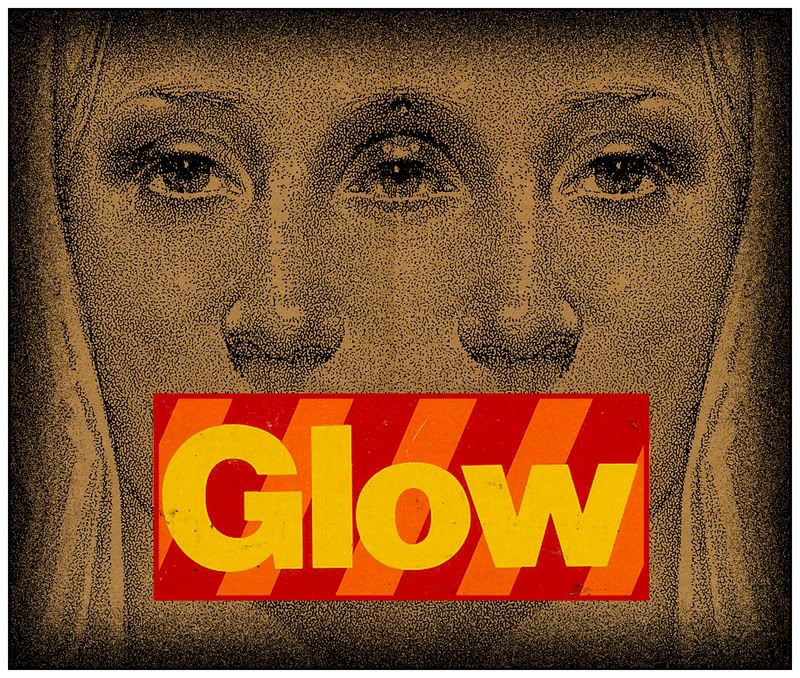
After having visited Budapest in, I think, April of that year and after having met the band there and after having heard them and seen them play and after recording with most of them (on this demos project I was working on there at Line Studios located then in the Petofi Csarnok) and after performing with them once, too, they asked me to contribute some designs for the new record that they were just on the verge of putting out. So, when I got back home, I went straight to work. I made several series for them to choose from. Some were in the style of my previous collection of abstract collage paintings, some were more in the vein of the Standard and Prime Assemblage work, and others were more a traditional collage with some photostatic elements, like these ones. All of this was pre-Adobe, mind you, all hand work, so I had all these 12"x12" illustration boards, some with quite a lot of relief on them (one design, I remember, even had a dead lizard glued to it). So, all stacked up and packed up in a big box. I sent them on, at some expense, to Budapest and awaited approval.
Sadly, that's pretty much the end of the story. I waited. I sent for an answer, but never heard a thing. Then one day, months later, I got a message that an international parcel had arrived for me at the airport from Hungary. I rushed down, of course, with great expectation, to fetch the thing, thinking it must be copies of the new CD, decked out in my stuff. Cool!
No, turns out it was just the original work I'd sent them, minus a few pieces, returned to me at my expense without so much as a "thank you but no thank you" note.
And that's the way it sometimes goes. Sometimes you get people to see things your way and sometimes you don't. And sometimes, when you can't get your vision or your pitch through, you never even hear about it. You hear one day that the guitar player from the group is into computer animation and that they decided to use some of his cartoons as the album art instead.
So it goes.
________________________________________________________________________
Here's another pitch I made to a group here in St. Louis just this past year.


I was inspired (loosely) to these designs based only on the band's name, Models Need Sleep, which I thought was a pretty interesting, enigmatic moniker. I'd never heard the music (I still haven't) but I knew Jon and Matt from Colony were in there so it had to be pretty cool. I spent a few evenings fooling around in Illustrator, found some images I liked and worked them in (the center one, my own favorite, is a picture my old friends, Fred and Floy, sent to me of their daughter, Katie, who is just too, damn cute!) and then I took a disc to one of their shows and wordlessly passed it to Jon, who slipped it in his back pocket. The result? You guessed it: nuthin. In this instance, though, it's a little more understandable since their guitar player, Grant, is such a very talented visual artist, too (fucking guitar players, man!). I got a look at their CD cover and it's this cool thing of upside-down water or something. It's neat and nothing even close to what I was going for, so...
________________________________________________________________________
The list, of course, goes on.
Here's a rough comp for an animated logo for the Hoffman/LaChance gallery here in town. The story is the same. Not a peep.

So the win-some-lose-some story isn't a new one. Clients who lack the courage for confrontation, or the courtesy to communicate and constructively critique (alliteration alert!) aren't news either. And if you know what it is to be a compulsive creative, then you know the scenario is destined to play out again, cause you know you can never quit. They gotcha.
On the flip side, of course, are the acceptances, the approbation and occasional accolades but I won't lie, the joy of acceptance is not proportional to the disappointment of rejection. I wish I could say that they balance each other out, that the elations make up for the depressions, but they don't. It would even be nice if I could say that at least the fight is a good one, that the cause is noble, but when you're simply feeding a compulsion, that's a pretty hard argument to win. Ultimately I guess we are all just creatures possessed of the need to continue, chess players in perpetual stalemate, gamblers fueled by hope and impulse but also knowing that the house always wins.
Goddamn! Am I some kinda fuckin' downer, or what? Jesus!
Next post, please!
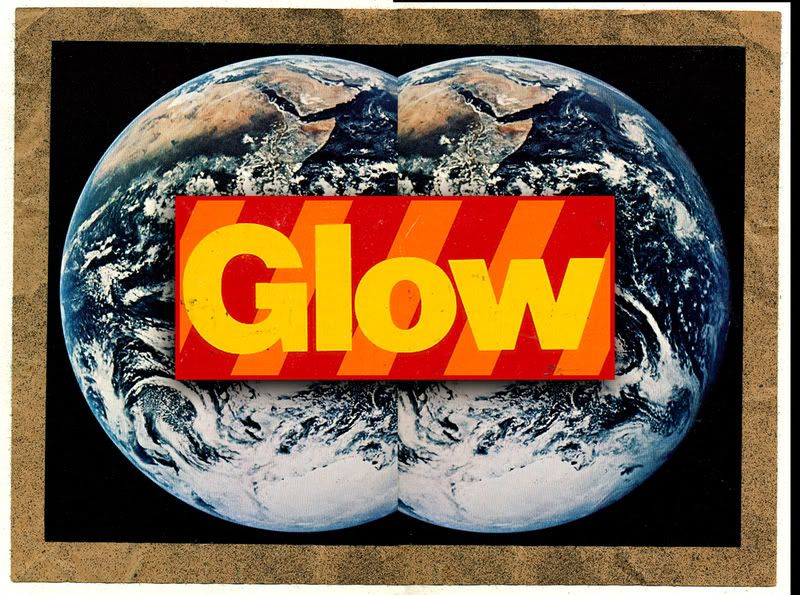
After having visited Budapest in, I think, April of that year and after having met the band there and after having heard them and seen them play and after recording with most of them (on this demos project I was working on there at Line Studios located then in the Petofi Csarnok) and after performing with them once, too, they asked me to contribute some designs for the new record that they were just on the verge of putting out. So, when I got back home, I went straight to work. I made several series for them to choose from. Some were in the style of my previous collection of abstract collage paintings, some were more in the vein of the Standard and Prime Assemblage work, and others were more a traditional collage with some photostatic elements, like these ones. All of this was pre-Adobe, mind you, all hand work, so I had all these 12"x12" illustration boards, some with quite a lot of relief on them (one design, I remember, even had a dead lizard glued to it). So, all stacked up and packed up in a big box. I sent them on, at some expense, to Budapest and awaited approval.
Sadly, that's pretty much the end of the story. I waited. I sent for an answer, but never heard a thing. Then one day, months later, I got a message that an international parcel had arrived for me at the airport from Hungary. I rushed down, of course, with great expectation, to fetch the thing, thinking it must be copies of the new CD, decked out in my stuff. Cool!
No, turns out it was just the original work I'd sent them, minus a few pieces, returned to me at my expense without so much as a "thank you but no thank you" note.
And that's the way it sometimes goes. Sometimes you get people to see things your way and sometimes you don't. And sometimes, when you can't get your vision or your pitch through, you never even hear about it. You hear one day that the guitar player from the group is into computer animation and that they decided to use some of his cartoons as the album art instead.
So it goes.
________________________________________________________________________
Here's another pitch I made to a group here in St. Louis just this past year.



I was inspired (loosely) to these designs based only on the band's name, Models Need Sleep, which I thought was a pretty interesting, enigmatic moniker. I'd never heard the music (I still haven't) but I knew Jon and Matt from Colony were in there so it had to be pretty cool. I spent a few evenings fooling around in Illustrator, found some images I liked and worked them in (the center one, my own favorite, is a picture my old friends, Fred and Floy, sent to me of their daughter, Katie, who is just too, damn cute!) and then I took a disc to one of their shows and wordlessly passed it to Jon, who slipped it in his back pocket. The result? You guessed it: nuthin. In this instance, though, it's a little more understandable since their guitar player, Grant, is such a very talented visual artist, too (fucking guitar players, man!). I got a look at their CD cover and it's this cool thing of upside-down water or something. It's neat and nothing even close to what I was going for, so...
________________________________________________________________________
The list, of course, goes on.
Here's a rough comp for an animated logo for the Hoffman/LaChance gallery here in town. The story is the same. Not a peep.

So the win-some-lose-some story isn't a new one. Clients who lack the courage for confrontation, or the courtesy to communicate and constructively critique (alliteration alert!) aren't news either. And if you know what it is to be a compulsive creative, then you know the scenario is destined to play out again, cause you know you can never quit. They gotcha.
On the flip side, of course, are the acceptances, the approbation and occasional accolades but I won't lie, the joy of acceptance is not proportional to the disappointment of rejection. I wish I could say that they balance each other out, that the elations make up for the depressions, but they don't. It would even be nice if I could say that at least the fight is a good one, that the cause is noble, but when you're simply feeding a compulsion, that's a pretty hard argument to win. Ultimately I guess we are all just creatures possessed of the need to continue, chess players in perpetual stalemate, gamblers fueled by hope and impulse but also knowing that the house always wins.
Goddamn! Am I some kinda fuckin' downer, or what? Jesus!
Next post, please!
Subscribe to:
Posts (Atom)

 Posts
Posts

